
How to Optimize Your Website for AI Search?
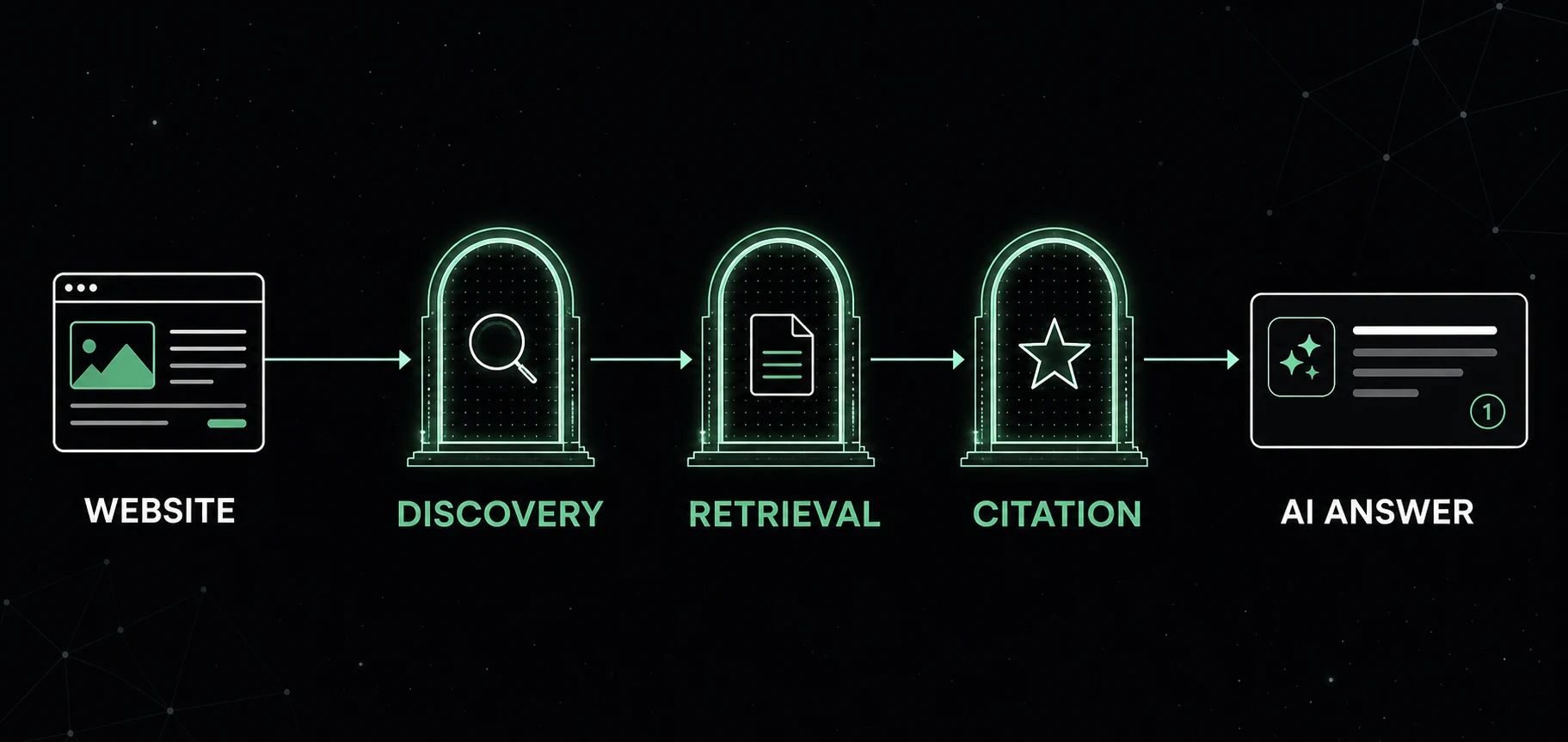
Search visibility now has three gates: discovery, retrieval, and citation. Passing the first no longer guarantees the other two.
Most advice about visibility still ends at indexing. Make the page crawlable, earn links, submit a sitemap, and watch the ranking move. That remains necessary. It is no longer the whole job.
A buyer can now ask ChatGPT, Claude, Perplexity, or Gemini which product fits a problem and receive a composed answer with a small set of sources. The product may rank in traditional search and still be absent from that answer. It may also be fetched and understood, then lose the citation to a page that states the same fact more clearly.
Search visibility now has three gates: discovery, retrieval, and citation. Being indexed clears only the first.
How AI Search Uses Your Website
Discovery asks whether a system knows the page exists. Traditional crawling, internal links, XML sitemaps, canonical URLs, and ordinary SEO do most of this work.
Retrieval asks whether the system can access the page when it needs evidence. That depends on crawler policy, firewall rules, response status, rendering, and whether the useful content arrives in the initial HTML.
Citation asks whether the page is good evidence for the question. A model has to identify the entity, isolate a relevant claim, judge the claim against other sources, and attach the source to an answer. Access does not guarantee any of those things.
Think of the process as a research desk. The index is the catalogue, retrieval is getting the book off the shelf, and citation is deciding that a particular page belongs in the footnotes. A catalogue entry is useful, but nobody cites the catalogue entry itself.
How AI Crawlers Work
"AI crawler" is too broad to be a useful policy category. The same company may operate one bot for search, another for model development, and another that fetches a URL because a user asked it to.
| Company | Search or retrieval | Model development |
|---|---|---|
| OpenAI | OAI-SearchBot, ChatGPT-User | GPTBot |
| Anthropic | Claude-SearchBot, Claude-User | ClaudeBot |
| Perplexity | PerplexityBot, Perplexity-User | Perplexity says these are not used to train foundation models |
Google Search uses Googlebot; Google-Extended controls separate Gemini training and grounding uses | Google-Extended is the relevant control token |
These distinctions come from the operators themselves. OpenAI documents OAI-SearchBot for ChatGPT search and GPTBot for content that may be used in model training. Anthropic separates Claude-SearchBot, Claude-User, and ClaudeBot. Perplexity distinguishes its automatic search crawler from user-initiated fetches. Google says Google-Extended does not affect inclusion or ranking in Google Search.
That makes a blanket allow or block a bundle of unrelated decisions. A publisher can allow search discovery while declining model-development crawling:
# OpenAI search visibility
User-agent: OAI-SearchBot
Allow: /

# OpenAI model-development crawling
User-agent: GPTBot
Disallow: /

# Anthropic search visibility
User-agent: Claude-SearchBot
Allow: /

# Anthropic model-development crawling
User-agent: ClaudeBot
Disallow: /

# Perplexity search visibility
User-agent: PerplexityBot
Allow: /
This is a policy example, not a universal recommendation. The right choice depends on what the site publishes and what rights it wants to grant. The important part is making each choice deliberately.
robots.txt is also only one layer. A WAF can block a permitted crawler before it reaches the application. User-agent strings can be spoofed. OpenAI and Perplexity publish IP ranges for verification, while other operators document different verification methods. A correct file paired with an overzealous firewall still produces an invisible site.
How to Make Your Content Useful
Once the right crawler can reach the page, the page has to make its case.
The strongest answer pages state the useful claim close to the heading that names the question. A pricing page should identify the price before explaining the philosophy of the plan. A comparison should name the actual differences before presenting a brand story. Documentation should put the working contract before the history of the feature.
This is not a request to flatten every page into a list of snippets. Essays can remain essays. Product, pricing, comparison, integration, and documentation pages have a different job: they are reference material. Their structure should make the answer easy to locate and hard to misread.
Evidence matters just as much as phrasing. Dates, methodology, product limits, named sources, and concrete examples make a claim easier to evaluate. Unsupported certainty is concise but weak. A specific claim with visible support gives an answer system something it can defend.
Consistency matters because citation begins with entity resolution. If one page calls the product an "AI GTM autopilot," another calls it a "cold email platform," and a third presents it as an "SEO agent," a reader has to decide whether those descriptions belong to one product or three. The same name, category, canonical domain, and core description should recur across the site without becoming robotic.
Make Your Pages Easy to Read
Client-side rendering can work for browsers and still create needless retrieval risk. Some crawlers render JavaScript; some fetchers do less; user-initiated tools may operate under tighter time limits. The safe default is simple: return the primary content, title, headings, canonical URL, and metadata in the initial HTML response.
Semantic HTML reduces ambiguity. Use an article for an article, a real heading hierarchy for sections, lists for enumerations, and tables for comparisons. A CSS grid that resembles a table to a person may arrive as a sequence of unrelated fragments to a parser.
Structured data is useful when it agrees with the visible page. BlogPosting, BreadcrumbList, Organization, Product, and genuine FAQPage markup can make page meaning explicit to systems that consume it. It is not a citation switch. Markup cannot rescue thin prose, and invented schema claims are worse than no schema at all.
Freshness should be legible rather than implied. Publish real datePublished and dateModified values, update them only when the content changes materially, and keep the visible date aligned with the structured data. A system cannot judge whether a claim is current when the page hides when it was written.
How to Use llms.txt
An llms.txt file is a compact markdown guide to the pages a site considers important. It can give tools and agents a clean description of the product, documentation, and canonical resources. It is inexpensive to publish and useful as a machine-readable index.
It is not part of the Robots Exclusion Protocol, and major answer engines do not promise that publishing one will improve citation. Treating it as a guaranteed ranking factor repeats an old SEO mistake: confusing a convenient machine format with evidence of adoption.
Publish it if it helps describe the site, then keep the fundamentals beside it: robots.txt, sitemap.xml, RSS where appropriate, canonical URLs, server-rendered pages, and strong internal links. The experimental file should complement the web, not become a second version of it.
How to Measure AI Search Visibility
There is no universal Search Console for answer-engine citations. That makes measurement less convenient, not impossible.
Start with server and edge logs. Record verified crawler traffic, requested paths, response status, cache behavior, and blocks at the WAF. This answers the first operational question: could the system reach the page at all?
Then maintain a small, stable set of buyer questions. Run them periodically across the answer products that matter, record whether the brand appears, which page is cited, and which competitors appear beside it. The sample will be imperfect because answers vary, but a consistent panel reveals changes that an occasional manual search will miss.
Finally, separate citation visibility from business outcome. A cited page that sends no qualified visits or conversions may be technically visible and commercially irrelevant. The useful path is question to citation, citation to visit, and visit to action. Optimizing only the middle creates another vanity metric.
Start With the Basics
The practical order is not mysterious. Decide which crawlers may do which jobs. Verify that the edge lets them through. Return useful content in the initial response. State claims plainly, support them, keep the product identity consistent, and publish machine-readable companions without mistaking them for guarantees. Then observe what actually gets fetched and cited.
The web has always had more than one reader. Sitemaps helped crawlers discover pages. RSS helped readers follow publications. Open Graph helped chat clients describe links. The current shift adds another reader with another task: assemble an answer and show its evidence.
The sites that earn citations will not be the ones that discover a magic file. They will be the ones whose pages remain useful after the interface disappears.